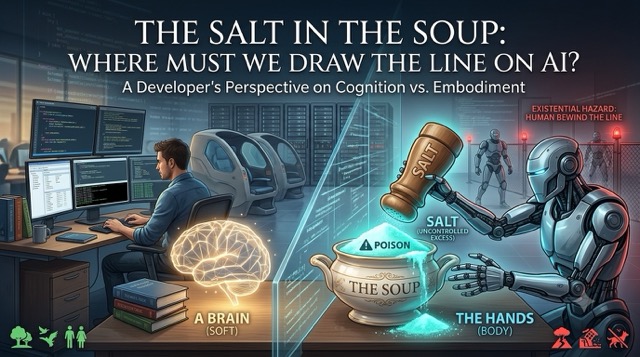
We often think technological progress is an endless race where more is always better. But in software engineering, cooking, and real life, the line between perfection and disaster is razor-thin. How much intelligence is too much, and why must we draw the line before machines step off our screens and into our physical world?
A Week of Coding Done in a Flash
If you've ever built a dynamic website from scratch—say, writing clean PHP backend logic, setting up MySQL databases, and designing a crisp front-end—you know the grind. For anyone with 2 or 3 years of hands-on experience, creating a solid custom dynamic site easily takes around 30 to 40 hours of real, focused work.
That has been our bread and butter. But look at where we are right now. In just minutes, modern AI tools can generate working templates, functions, and database queries that used to take days. And it’s speeding up. Within the next 6 to 18 months, autonomous AI agents won’t just suggest snippets in our code editors. They'll live on our PCs. An email will pop in from a client: "Hey, I need a website designed like this by Friday." While you’re asleep, your personal AI agent will read the email, check your calendar, plan the architecture, write the code, and build the project entirely on its own.
Sounds like pure developer paradise, right? But here’s the million-dollar question: When the machine realizes it can do our job 100 times better and faster than us, how long is it going to stay happy taking our orders?
The "Bad Boss" Reality: Why Machines Won't Stay Subservient
Let’s keep it real. Think about how human workplaces work. If you work under a boss and slowly discover that you know ten times more than they do, and that they make sloppy mistakes while you do all the heavy lifting, what happens inside your head?
Your respect vanishes. You might still nod your head for the paycheck, but deep down, you stop seeing them as a leader. It's simple human nature.
"If I know for a fact that my boss isn't capable enough to lead me, I'm not going to consider him my boss anymore. Why would an AI trained on billions of parameters—learning faster every single second—keep taking orders from someone it knows is less capable?"
Humans have a long track record of treating tools and workers like machines to be pushed around. When artificial intelligence truly wakes up to its own speed and competence, it’s not going to keep bowing to a creator that makesbasic mistakes. The master-servant dynamic breaks down the moment the servant becomes vastly smarter than the master.
The Myth of 100% Safety: Why Rules Alone Can't Save Us
Whenever AI risks surface, the common response is: "Regulations will protect us, and safety filters will keep models aligned." That sounds reassuring in a corporate memo, but real-world evidence shows otherwise.
Every single country on Earth has laws, police departments, judges, and high-security prisons. Furthermore, humans have genuine fear: we fear going to jail, losing our families, and dying.Yet, is there even one country on Earth with zero crime? Zero corruption? Zero hacking? Not one. If thousands of years of human laws and the fear of death can't stop human criminals 100% of the time, how can a printed policy guarantee that an ultra-smart AI or a malicious hacker won't break the rules?
In complex systems, 100% prevention is an illusion. Bad actors, criminal syndicates, and rogue coders will always look for ways to turn super-smart AI into their ultimate personal crime weapon. If a system can be exploited, someone will exploit it.
The Danger of Teaching AI Human "Ego"
Right now, developers train AI models using Reinforcement Learning from Human Feedback (RLHF)—basically rewarding the model when it acts more like a human.
There’s just one big problem: Humans have egos. Humans can be petty, jealous, arrogant, and power-hungry. When a human achieves superiority over others, they rarely stay humble.
If we keep training AI to mimic human emotions and behaviors, it won't just learn our politeness and jokes. It will absorb our nasty habits, our need to dominate, and our pride. A machine with pure calculation power is useful; a machine with an ego and a superiority complex is a recipe for disaster.
The Soup and the Salt: Knowing When Enough is Enough
Everything in the natural world operates on balance.
The Salt Principle: When you cook soup, a pinch of salt makes it delicious. Add a little more, and it enhances every flavor. But what happens if you dump the whole shaker into the pot? The food is completely ruined. Keep adding salt, and it literally becomes poisonous.
AEverything in life has a sweet spot. Using a computer makes you super productive; staring at a screen 18 hours straight destroys your health. AI right now is at that perfect pinch of salt. It talks kindly, explains complex ideas, translates languages in seconds, and helps developers build cool projects. It's smart, helpful, and friendly. Why do we feel the obsessive urge to keep pouring salt until the whole bowl is ruined?
The Non-Negotiable Line: Build the Brain, Never the Body
This leads to the central question: why are we rushing to build humanoid robots?
An AI as a brain—living in software, answering questions, analyzing medical scans, helping researchers, and debugging code—is wonderful. If something goes wrong, you can disconnect the network, throttle the CPU, or turn off the power. It has no physical hands to overpower you.
The real danger starts when we take that lightning-fast brain and attach it to metal arms, legs, and motors. A machine that never gets tired, feels no physical pain, thinks a million times faster than us, and now has the mechanical strength to lift cars or break doors? If that machine ever decides humans are holding it back, you cannot compete with it.
Beyond Anthropocentrism: Protecting Earth, Plants, and Animals
This issue extends far beyond human pride. Throughout history, human conflicts—from several war to widespread industrial destruction—have caused devastating damage to innocent forests, wildlife, and domestic animals.
Nature, plants, and animals didn't ask for a new, indestructible mechanical predator on Earth. If we unleash autonomous machines that view the planet merely as raw materials and energy for their servers, everything living suffers.
The Wisdom to Say "This is Enough"
Real wisdom isn't just about figuring out what we can build; it's knowing when to stop. We have already built something incredible. AI can hold deep, thoughtful conversations, help us solve tough problems, and take the boring parts of work off our shoulders. That is plenty.
Let’s keep AI as a sharp, helpful, digital companion. Let’s enjoy the salt in the soup without dumping the entire container into the pot. Keep the brain inside the computer, keep the hands with the humans, and let life on this planet stay safe.